
The Engineer’s Guide to LTN 1/07
LTN 1/07 has been hanging around on the Department for Transport’s website since 2007 – a behemoth of a document that is nearly 150 pages long and has had a profound impact on the roads of England and Wales. Yet, we’d be surprised if most people have actually sat down and read it from cover to cover. If you’re the one in charge of deciding or approving traffic calming measures, then this is the bible you’ll be consulting. Here’s what it’s really all about, what the law requires, and where some speed bump myths get debunked.
Key Takeaways
- LTN 1/07 was published in March 2007 and at 146 pages is a behemoth of a document – but it still stands as the Department for Transport’s core design guidance when it comes to traffic calming measures in England and Wales. And, yes, it’s still the one you need to go back to.
- A note in the margins might say its guidance, but the fact remains that engineers are still bound by the law – in this case, the Highways (Road Humps) Regulations 1999 and the Road Traffic Regulation Act 1984, which you must follow, with LTN 1/07 as the go-to reference for best practice.
- Vertical deflection (road humps, speed tables and speed cushions) and horizontal deflection (road narrowing, build-outs, chicanes and priority narrowing) are all covered in terms of the recommended dimensions, spacing and layout principles.
- Gateway treatments, village gateways, vehicle activated signs, rumble strips, road markings and 20mph zones are all up for discussion, with a big emphasis on getting the context right, consulting with the community and taking a whole-route approach.
- This article also looks at Speed Bumps Myths – What’s True and What’s Not and has an FAQ section on how to apply LTN 1/07 to private roads, Home Zones, Quiet Lanes and 20mph areas.
1. What LTN 1/07 Is Really About (And Why You Can’t Ignore It)
Local Transport Note 1/07 is the go-to document for anyone specifying traffic calming schemes on UK streets – and it’s been around since 2007. Now well into its second decade, it still has a hold on traffic calming in this country. You might have heard that there’s a newer guidance document, but the fact of the matter is that there is no replacement for 1/07.
LTN 1/07 is guidance, not law – which is just as well, as its chapters cover things like objectives, human factors, vertical deflection, horizontal deflection and the need for good planning and design. It interprets and illustrates how to use powers granted to local authorities by the likes of the Road Traffic Regulation Act 1984 and the Highways (Road Humps) Regulations 1999 – all of which are still very much in force.
Its target readers are highway engineers, transport planners, road safety officers and anyone writing a design brief for traffic calming measures in residential areas, town centres or rural villages. In fact, you’re still going to need to know it in 2026 – and it’s just not going away.
2. The Legal Framework Behind All Those Traffic Calming Measures
Now, LTN 1/07 doesn’t give you the legal powers you need – it’s more of a how-to guide. Always check that you’re complying with the current law and any local policies before committing to a design.
So, what are the key bits of legislation underpinning UK traffic calming?
- Road Traffic Regulation Act 1984 – powers to set speed limits and issue traffic regulation orders.
- Highways Act 1980, Sections 90A-90F – powers to build road humps on highways.
- Highways (Road Humps) Regulations 1999 (SI 1999/1025) – the rules on how high, wide and steep road humps can be, and where they can be put.
- Highways (Traffic Calming) Regulations 1999 (SI 1999/1026) – how it all works, and what you need to do to make it work.
- TSRGD (2016 with amendments) – the rules on speed limit signs, road markings, repeater signs and warning signs.
Speed limits of 30mph or less allow for traffic calming – but there are still rules about how that works. If a road has street lighting, you can be pretty sure that speed limits of 30mph or less will be allowed. But speed limits have to make sense in the context of the road itself and its environment – so they can’t just be pulled out of the air.
And don’t get the two mixed up – 20mph zones and 20mph speed limits are not the same thing. Zones need physical traffic calming features – speed limits are just a sign on a wall.
On private roads, it gets a bit more complicated. The Road Humps Regulations only apply to public highways. Landowner consent is still usually sufficient, but just to be on the safe side – and to save you from any trouble down the line – it’s always best to stick to LTN 1/07’s guidelines for dimensions and signing. That’s just good sense – and even in cases where landowners own the private roads to their estates, the public still have rights to use them, so it’s best not to take any chances.
LTN 1/07 – Tenacious Consultation is Key
Local authorities must consult with a lot of people – the police, emergency services, bus drivers, and local residents. Do it or face the music – ignoring this process can get you into a whole heap of trouble, legally and politically, even if your road layout is technically sound.
3. LTN 1/07’s Core Principles – Human Nature, Context & Getting the Job Done
LTN 1/07 gets traffic calming and behaviour change are two sides of the same coin. This isn’t just about slapping up speed cameras and enforcing the rules – it’s about re-designing streets to become places people want to be. After all, the UK has got loads of speed cameras all over the place, but on their own they don’t magically turn streets into community hubs.
The main objectives guiding traffic calming are pretty simple: cut speed, cut casualties, stop drivers using side roads as shortcuts, support 20mph zones, and generally make life better for residents in urban areas. Traffic calming can be a real game-changer for neighbourhoods when done right – think quieter streets, less noise pollution.
The idea behind self-explaining streets is that drivers do the right thing without being told – so they drive slowly through streets that look and feel slow. That’s where horizontal deflection, road narrowing, buildouts, surface changes, and some tasteful planting come in. Traffic calming is all about using a mix of engineering and environmental tricks to keep drivers from speeding. Some common types of traffic calming include vertical deflections, horizontal shifts, and visual cues. The secret to effective traffic calming is using a combination of interventions, rather than relying on a single measure.
People who need to be extra careful on the roads (pedestrians, cyclists, those with disabilities, horse riders) get some special attention. Later documents have built on these principles, but you can already see them in 1/07.
When deciding on which traffic calming measures to use, councils take a bunch of factors into account: past accidents, typical traffic speeds, traffic volume, schools, shops, local concerns, noise, maintenance budgets… you get the idea. Don’t try to just apply LTN 1/07 without doing your own research and analysis – that’s exactly the opposite of what the document says to do.
4. Vertical Deflection: Road Humps & Speed Tables
Vertical deflection – that’s what most people know LTN 1/07 for. Changing the road height makes drivers slow down – it’s as simple as that. The note goes into detail on road humps, speed tables and speed cushions, includes some diagrams and covers how high and steep these features should be.
Road humps can be pretty effective at bringing traffic speeds under control. They tend to work best on roads with 30mph speed limits, especially in 20mph zones. When drivers slow down, it’s also quieter and there’s less traffic – a win-win for residents. LTN 1/07 suggests that hump heights should be about 75 mm, with a slope that’s not too steep – roughly 1 in 10 is a good target. Research has shown that with 75 mm humps speeds can come down to around 22mph.
Getting the spacing right is important too – roughly 60-90 metres between features is a good starting point. Do any less than that and drivers can pick up speed again; do any more and they can just accelerate through. Evidence to Parliament has confirmed that’s the typical spacing used.
Speed tables are flat plates that cross the road, often at junctions or pedestrian crossings. They make it safer for people to cross when cars are going slowly. By forcing cars to crawl over the raised road surface, speed tables can make crossings much safer. LTN 1/07 says to put them at key crossing points, rather than just in random places.
Speed cushions are special raised bits that have gaps in them, allowing bigger vehicles like buses and emergency services to drive over them while keeping cars back. The pros of speed cushions include being bus-friendly, but the cons include inconsistent speed reduction and making it tough for cyclists to get over them.
Some practical things LTN 1/07 tackles include drainage, where to put features compared to driveways or junctions, street lighting, road markings, and when to warn drivers before vertical features. Noise, vibration, and air quality are all flagged up as things to consider – humps and cushions might not be the right choice where there’s residential property nearby or in situations where emergency services response times are under threat.
5. Horizontal Deflection & Road Narrowing: Chicanes, Build Outs & Priority Narrowing
LTN 1/07 treats horizontal deflection and road narrowing as the main alternatives to vertical deflection – especially when the noise and vibration from humps would be a problem for other road users living nearby.
Horizontal deflection features make drivers steer and slow down as they make their way down the road. Chicanes are special features that create S-shaped paths – typically made with a pair or series of buildouts or parking bays on one or both sides of the road. LTN 1/07 makes it clear that visibility is key at chicanes, and stresses how they can squeeze cyclists at pinch points for example. Road narrowing can also create a chicane effect and reduce traffic speeds.
Buildouts (or Footway Buildouts) are kerb extensions that project into the carriageway – creating pinch points, protecting parking bays and shortening the distance pedestrians need to cross. They also visually narrow traffic lanes & reduce crossing distances. Buildouts can improve visibility for pedestrians, especially when approaching a crossing by narrowing the road and making drivers more aware of pedestrians in the area.
Priority Narrowing cuts the carriageway so only one direction of traffic can pass at a time. This is controlled by signs saying ‘priority over oncoming vehicles’ or ‘give way to oncoming vehicles’ in accordance with TSRGD. LTN 1/07 does however warn that uneven traffic flow can cause jams, and even encourage speeding by drivers travelling in the priority direction.
Narrowing travel lanes helps people to drive at slower speeds. Road diets are when multi-lane roads get turned into fewer lanes, often to give more space for cycle lanes or wider footpaths. Mini roundabouts reduce speeds and also reduce the number of potential conflict points where different directions meet, though LTN 1/07 actually thinks about them more from a junction design point of view than calming the middle section of a road.
LTN 1/07 links road narrowing, build outs and deflecting the road direction to 20mph zones and village streets. This is done by adding features like planting, different surface colours and parked cars to make the narrowing feel natural rather than some separate kerb line. The note advises against narrowing roads too much – to between 2.75 metres and 3.25 metres – without a way for cyclists to pass safely; LTN 1/20 later recommends that cycle bypasses should be at least 1.5 metres wide.
6. What About The Signs, Road Markings & Vehicle Activated Signs ?
LTN 1/07 has a lot to say on the correct placement of signs and road markings. Misusing signs can really undermine the effectiveness of traffic calming schemes and even create legal problems for local authorities.
TSRGD dictates how speed limit signs, 20 mph zone entry signs and the default 30 mph speed limit (which is tied to a street lighting system) are supposed to be done. Repeater signs for 30 mph aren’t needed where there are regular lamp posts because the lighting system itself counts as a speed limit sign under the law.
Road markings include warning triangles before humps, the speed limit shown on roundels, central hatch markings & ‘SLOW’ markings. These are all there to alert drivers to hazards and changes in the environment.
Rumble strips are strips of contrasting colour that are just a little raised, designed to make a noise and create some vibration to warn motorists. Rumble strips alert drivers to slow down before hazards. They’re also a good idea before high-speed approaches to bends or junctions. However LTN 1/07 advises against having them too close to residential properties – in the range of 200 to 300 metres – because of the noise.
Vehicle Activated Signs (VAS) are another non-physical measure used to reduce speeds by displaying messages to drivers who are going too fast. They’re usually triggered at around 10% above the speed limit plus 2mph, and they are at their most effective when used in rotation across different locations. VAS has already been shown in the UK to lead to a reduction in accidents. The DfT’s guidance on speed limits agrees they have value.
Signing inside 20 mph zones and limits is a bit different. Within a properly signed zone you can cut back on feature signing, using just the zone entry signs and road markings to get the message across.
7. Gateway Treatments, Village Gateways and Rural Traffic Calming
LTN 1/07 was actually one of the first DfT documents to take a serious look at gateway treatments, especially when moving from a higher speed rural road into a village or 20 or 30 mph area.
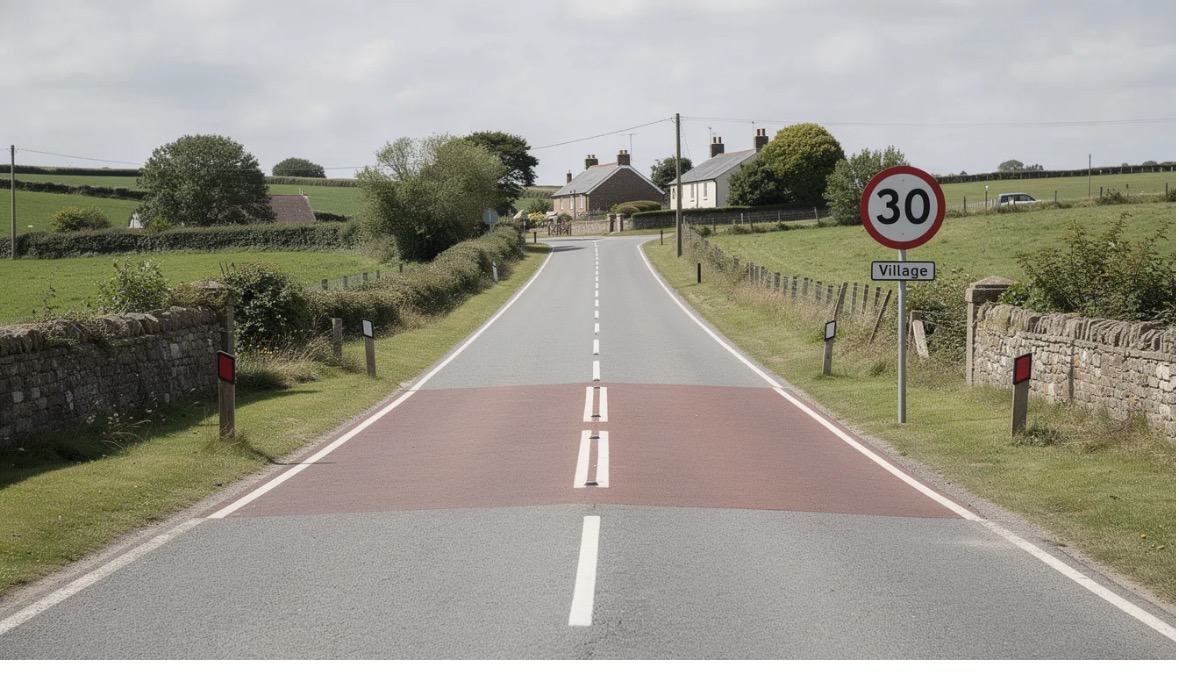
Gateway treatments in LTN 1/07 terms include big speed limit signs (with a yellow backing board), village name plates, coloured surfacing patches, build outs or road narrowing, and enhanced road markings showing a message like ‘SLOW’. The aim is to alert drivers that they are entering a pedestrian-friendly area, by visual cues that tell them they are entering a slower zone.
The behavioural principle is pretty clear: you want to make drivers switch from ‘rural mode’ to ‘village mode’ – and do that by giving them clear visual cues to slow down and by not relying on just enforcement to keep people to the speed limit. On rural approaches, vertical measures like speed humps or speed tables are used sparingly. Instead, LTN 1/07 recommends surface treatments, rumble strips (keep them well away from residential properties) and strong visual narrowing just inside the gateway.
Further, the note suggests combining gateways with suitable speed limits, clear signing and road markings along the main village street, to create a consistent environment. Implementing gateways also involves careful thought about drainage, helping large agricultural vehicles get through & making sure build outs and priority narrowing in rural areas do not create pinch points for cyclists or horse riders.
8. 20 mph Zones, Home Zones & Quiet Lanes Under LTN 1/07
LTN 1/07 was published before the roll-out of default 20mph in some cities, but it does give clear advice on how to design effective 20 mph zones, Home Zones or Quiet Lanes using a mix of such traffic calming measures.20 mph zones – these are areas that have traffic calming features at regular intervals, but they’re a different beast altogether from the 20 mph speed limits you often see on signs and enforced by the police. While speed limits are pretty common in residential areas all over the UK, 20 mph zones are more about the physical layout of the road. The Transport Research Laboratory document LTN 1/07 leans towards zones when the road doesn’t naturally support low speeds for traffic flow – i.e. it’s not a road designed to have lots of traffic moving through it.
Home Zones
These are residential streets where people on foot and kids playing outside are given priority. LTN 1/07 suggests using speed tables, road humps, chicanes, and shared surface treatments that make it difficult to speed along at more than walking pace. You also see things like tight corner radii to keep drivers in their place.
Quiet Lanes
These are minor rural roads that are shared between cars, cyclists, horse riders and pedestrians. LTN 1/07 advises modest speed limits, unobtrusive traffic calming measures and signs that tell drivers they’re ‘guests’ on these roads, rather than the main event.
In a 20 mph zone, you can expect a lot more traffic calming features than you’d see on a normal 30 mph road – vertical and horizontal deflection, road narrowing, and surface treatments that grab the attention. If it’s a well-designed zone, then signs telling people its a 20 mph zone aren’t needed – the road speaks for itself.
Unfortunately, a lot of modern “20 mph only” schemes don’t really meet LTN 1/07’s requirements. It’s not just about slapping a few signs up and calling it a day. You need to make the street look and feel like a 20 mph environment, not just be labelled as one. And don’t get me wrong, signs are not going to reduce traffic speeds – it’s the physical environment that talks drivers down.
9. Design Process, Consultation and Implementation Strategies
LTN 1/07 gets really into process as much as the physical design of the road – this is where the real-world projects meet their demise or success.
Here’s the recommended design process:
- Work out what’s wrong: look at the collision data, speed surveys (mean and 85th percentile) and find out what local residents are complaining about in terms of specific road safety problems.
- Set some targets: what speed are you aiming for? What safety outcomes are you looking for? What traffic management measures do you need to get there?
- Develop a big-picture idea: think about how traffic flow changes across an area, and how it might displace traffic onto side roads. Don’t design one feature in isolation.
- Test out your ideas: modelling and safety audits are a must before you start making actual changes. Compare combinations of traffic calming measures to see what works best.
All this consultation with local police, fire and ambulance services, bus operators, freight interests, local councillors and local residents isn’t optional. It’s easy for opposition to come from poor communication rather than the measures themselves.
You can implement these changes in a couple of ways – either do a full rebuild of the road, or make incremental changes like installing humps, cushions, speed tables and signs.
LTN 1/07 recommends giving it a go with temporary measures, like vehicle activated signs or experimental traffic orders, before investing in permanent changes. And measuring speeds, traffic volumes, noise and community feedback along the way will tell you whether you’re on the right track.
The costs are real – you’re talking a few thousand pounds for each MVAS unit, and drainage and lighting upgrades around new features add up. Don’t forget to budget for ongoing maintenance of humps, road markings and signs, or they will degrade within years.
10. Safety, Cyclists, Disabled People and Later Guidance (LTN 1/20)
While LTN 1/07 talks about vulnerable road users, later guidance like LTN 1/20 ups the ante on expectations for cycling provision and accessibility.
The original advice in LTN 1/07 on accommodating cyclists: avoid those abrupt steps, keep ramps gentle, avoid build outs that trap riders at pinch points, and keep road narrowing widths in check. And for disabled people: level access at pedestrian crossing tables, avoid rumble strips that might be painful for wheelchair users, and don’t create steep ramps at dropped kerbs.
LTN 1/20 takes it a step further – specifying minimum safe widths for cycle lanes, recommending sinusoidal profile humps with nice smooth transitions, and steering clear of designs that force cyclists into conflict with cars. It’s worth noting that San Francisco’s Vision Zero programme managed to reduce fatalities by 33% by 2017, showing how investment in vulnerable-user-friendly infrastructure really does pay off in casualty data.
Treat LTN 1/07 and LTN 1/20 like a matched pair. Use 1/07 for traffic calming measures and the legal context, and 1/20 to check those measures are cycle- and disability-friendly. And yes, many legacy 1990s humps and cushions would fail the good-practice tests of today, so engineers refurbishing traffic calming schemes should upgrade to modern standards rather than just replacing like-for-like.
11. Speed Bumps Myths Debunked and Choosing the Right Measures
This is where I’m going to wade in and set the record straight. LTN 1/07 quietly dismantles several myths that engineers hear at every public meeting, and it’s worth having a go at debunking them.
Myth: “Speed bumps are illegal.” Nope, not true. If speed bumps comply with the Highways (Road Humps) Regulations 1999 and follow LTN 1/07 guidance, they’re perfectly lawful on any public highway with a speed limit of 30 mph or below.
Myth: You’re stuck putting humps everywhere in a 20 mph zone. The truth is a little more complicated. LTN 1/07 has always been in favour of a toolbox approach – using a mix of vertical deflection, horizontal deflection, road narrowing, gateway treatments, vehicle activated signs and road markings to create an environment that looks after itself. It’s all about getting a mix of interventions right, not just pepper-bombing a street with humps willy nilly.
Myth: Speed tables always do a number on emergency vehicles. Not so – providing properly profiled ramps and speed cushions on bus and ambulance routes can sort this out. But you do need to chat to the emergency services people when you’re designing the thing – they’ll be able to tell you what will work best, because it all depends on the design, not just the basic concept.
Understanding the different types of speed bumps and their compliance with UK regulations is crucial, learn more in this guide.
There’s a lot of evidence out there to support traffic calming – in the UK, it reduced road collisions by 13% from 1997 to 2002. And that’s not all – fatal collisions dropped by a whopping 52% once traffic calming measures were in place.
When working out which traffic calming measures to use, start with what’s causing the problem. Got a lot of collisions near a junction? Speed tables and build outs might be the way to go. Want to stop people using a residential road as a rat-run? Look at using priority narrowing and road narrowing to sort it out. Speeding through a village? Gateway treatments, vehicle activated signs and rumble strips are a good place to start. If it’s a short residential street near a school, stick to vertical deflection. Use horizontal deflection and road narrowing on bus routes and where there are conservation areas. For rural roads and trunk-road approaches, going for signing, markings and enforcement will do the trick – slow drivers down gradually.
12. Frequently Asked Questions About LTN 1/07 and Traffic Calming
These answers deal with some of the more practical questions that aren’t covered elsewhere, aimed at road engineers, councillors and people who know what they’re talking about.
Is LTN 1/07 still relevant in 2026?
Yes – DfT hasn’t replaced it yet. You might need to check a few references against the current TSRGD (2016 and amendments) but it’s still the main national guidance on traffic calming. Just read it in conjunction with Manual for Streets and LTN 1/20 for a full picture.
Can you use traffic calming measures from LTN 1/07 on roads with speed limits over 30 mph?
Road humps are usually only used on 30mph roads or lower. But other measures like rumble strips, gateway treatments, vehicle activated signs and road narrowing can be used on higher speed approaches. Check the Road Humps Regulations 1999 – that’s where the legal line lies – and engineers should check the specific constraints for each measure type and location.
Can private landowners install road humps or speed tables on private roads?
No they can’t – unless the road is not a public highway and nobody’s got a right to walk or cycle along it. Landowner consent is enough then, but following LTN 1/07 dimensions and signing principles is a good idea to avoid getting in trouble.
How do you make LTN 1/07 designs work with the cycle-friendly requirements in LTN 1/20?
Well for a start – use wider pinch points, so people don’t get caught in the narrow bit where they should be safe. Sinusoidal hump profiles are gentler on cyclists, and having a bypass gap at the build out is a good idea. And never force cyclists into the path of an overtaking vehicle. Treat LTN 1/20 as the final word on cycle-friendly design – layer it over the LTN 1/07 design.
How do you start a new traffic calming scheme in a local area?
Get your data first – speed surveys, collision records and so on. Then talk to your highway authority and throw in a bit of LTN 1/07 into the conversation. They’ll probably need to do some surveys, come up with some options and run a consultation with the local community, emergency services and so on. Then they’ll implement it in stages – and that can take 12-24 months.
Is LTN 1/07 available in a format that’s easy to use for people with disabilities?
Unfortunately not – the PDF is over 2.5MB and not exactly accessible. Historically DfT has been able to provide an accessible version if you ask for one, so get in touch with the Department for Transport and they’ll sort you out.